Greener Solvents: Are We Solving the Right Problem?
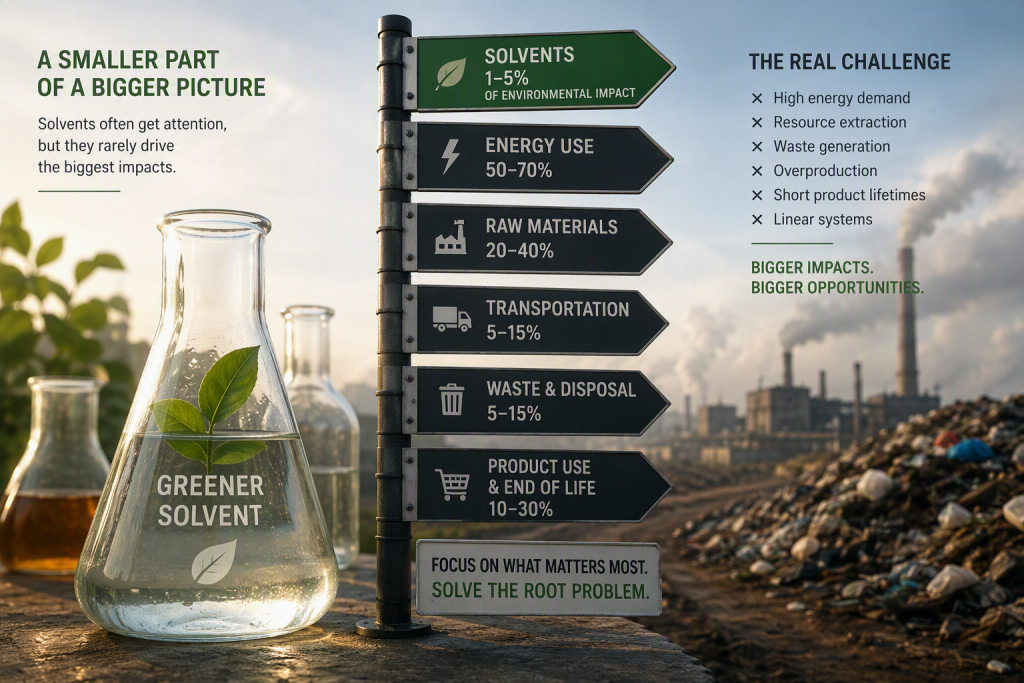
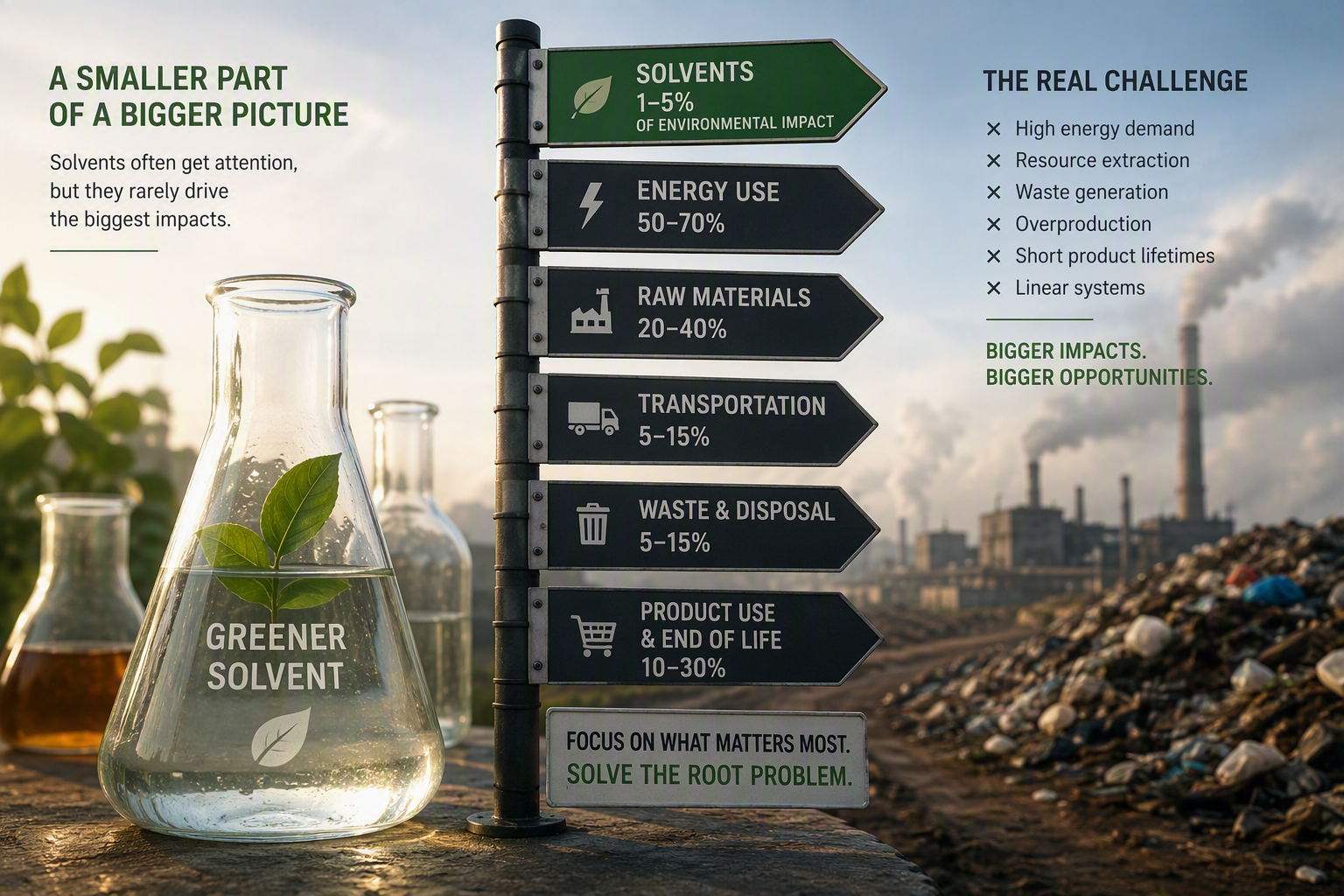
This article is intended as food for thought rather than a definitive position. The goal is not to argue against greener solvents, but to challenge whether solvent substitution alone addresses the most important sustainability challenge facing the chemical industry.
Before going further, it is important to make one thing absolutely clear: worker safety must remain a top priority. If a solvent poses unacceptable health risks, replacing it with a safer alternative is the right thing to do. I am fully in favor of eliminating hazardous exposures rather than relying solely on protective measures to manage them. The health and wellbeing of people working in our industry should never be compromised in the name of process efficiency or sustainability.
That said, I sometimes wonder whether the discussion around greener solvents focuses too much on which solvent we use, and not enough on how we use solvents in the first place.
The Case for Greener Solvents
Advocates of greener solvents highlight several important benefits:
- Reduced toxicity to workers and local communities.
- Lower emissions of volatile organic compounds (VOCs).
- Reduced environmental persistence and bioaccumulation.
- Improved regulatory compliance.
- Potentially lower carbon footprints during production.
Examples include bio-based solvents derived from renewable feedstocks, solvents with lower toxicity profiles, and alternatives to traditional solvents such as NMP, DMF, or dichloromethane.
These developments represent genuine progress, especially in applications where hazardous solvents can be replaced without compromising performance.
The Missing Perspective: Solvent Consumption
However, focusing exclusively on solvent chemistry can obscure a more fundamental issue. A solvent that is 20% less toxic but is used in vast quantities and discarded after a single use may still contribute significantly to environmental impacts.
In many sectors, including pharmaceuticals, specialty chemicals, coatings, and cleaning operations, solvents represent the largest mass flow entering and leaving a process. The sustainability challenge is therefore often linked less to the identity of the solvent and more to the volume consumed.
A process that requires ten tonnes of a "green" solvent may ultimately have a larger environmental footprint than a process requiring one tonne of a conventional solvent that is efficiently recovered and reused.
Incineration: The Hidden Sustainability Problem
An often-overlooked aspect of solvent use is the fate of spent solvent streams. Despite advances in green chemistry, a substantial portion of industrial solvent waste is ultimately sent for incineration.
Incineration is frequently presented as a responsible waste management route because it destroys hazardous contaminants and can recover some energy. Yet from a circular economy perspective, incineration remains a linear solution. Valuable carbon-based molecules are destroyed rather than retained within the economy.
This raises an important contradiction. Consider a bio-based solvent produced from renewable feedstocks. If that solvent is used once and then incinerated, the process is still fundamentally linear. While the carbon may have originated from renewable resources, the material itself is not kept in circulation.
For me, this is where the discussion often becomes uncomfortable. We celebrate greener solvents, but relatively little attention is given to the fact that many of them ultimately end up in an incinerator. Replacing a fossil-derived solvent with a bio-based alternative does not automatically create a circular process if the end-of-life scenario remains solvent destruction.
Circularity Should Be the Priority
A truly sustainable solvent strategy should prioritize:
- Solvent recovery and purification.
- Internal reuse and recycling loops.
- Process intensification to reduce solvent demand.
- Alternative separation technologies.
- Design for closed-loop manufacturing.
In this context, a conventional solvent recovered and reused dozens of times may outperform a greener alternative that is regularly disposed of through incineration.
The hierarchy should perhaps resemble the principles we already apply elsewhere in sustainability:
- Avoid solvent use where possible.
- Minimize solvent consumption.
- Reuse and recycle solvents.
- Recover value from waste streams.
- Incinerate only as a last option.
Unfortunately, much of the current discussion seems to start at solvent substitution rather than at solvent reduction and circularity.
The Risk of Greenwashing
The emphasis on greener solvents also carries a risk of unintended greenwashing. Companies may highlight the use of bio-based or low-toxicity solvents while continuing highly linear consumption practices.
A sustainability claim based solely on solvent selection can be misleading if it ignores:
- Recovery rates.
- Reuse cycles.
- Waste generation.
- Incineration volumes.
- Total lifecycle emissions.
A greener solvent is not necessarily a sustainable solvent if it is continuously consumed and ultimately destroyed.
Conclusion
Greener solvents undoubtedly have an important role to play, particularly when they improve worker safety and reduce harmful environmental impacts. Those benefits are real and should not be underestimated.
However, I am not convinced that greener solvents are the industry's biggest sustainability challenge. The real issue may be that solvents are still used within a largely linear system. As long as significant volumes of solvent end their life in incinerators, we are treating symptoms rather than addressing the underlying problem.
Perhaps the conversation should evolve from "Which solvent should we use?" to "Why are we using so much solvent, and how do we keep it in circulation?"
Only then can solvent management move beyond being merely less harmful and become genuinely sustainable.