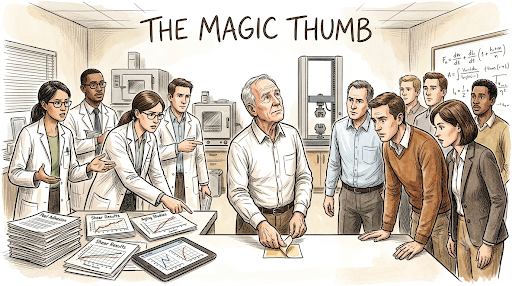
The Magic Thumb
For an industry that spends an incredible amount of time generating data, we have a strange habit. We don't always trust it.
Instead, we trust Dave's thumb. Or Sarah's thumb. Or that one colleague who's been in the industry for 30 years and can apparently evaluate an adhesive more accurately than a full testing laboratory.
You know exactly what I'm talking about.
A new sample arrives. Someone peels off the liner. Presses their thumb into the adhesive. Pulls away. Pauses. Looks at the ceiling for a second. Then delivers the verdict.
"Nah, doesn't feel tacky enough."
And suddenly the atmosphere in the room changes. People start looking at the sample differently. Doubts emerge. Questions arise. Months of development work are now standing trial. Against a thumb.
What I love is that nobody officially acknowledges this process. We present ourselves as a highly technical industry. We discuss rheology, viscoelasticity, surface energy, peel adhesion, dynamic shear performance. Then somebody grabs a sample and says:
"This one feels stronger."
And somehow everyone knows exactly what they mean.
The worst part?
The thumb is not completely useless. If it were completely useless, we'd all ignore it. But experienced people do develop instincts. After enough years handling tapes, labels, and adhesive coatings, you start recognising things. Sometimes the gut feeling is actually right. Sometimes the experienced operator notices something before the data does. That's what makes the Magic Thumb so dangerous. It's right just often enough to gain credibility.
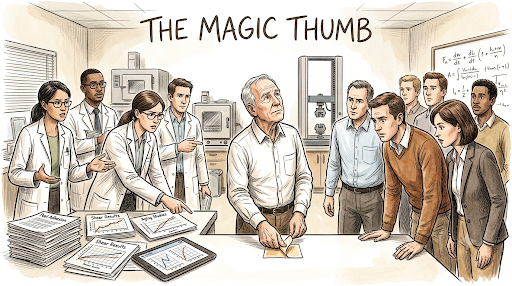
I remember sitting in a review meeting years ago. The team had generated piles of data.
Peel results, shear results, aging studies, customer trial data.
Everything indicated the adhesive was performing exactly as intended.
Then somebody picked up the sample, pressed their thumb into it, looked slightly disappointed and said:
"Still doesn't feel very aggressive."
For a moment, twenty pages of technical evidence entered a debate with one thumb...............and the thumb was winning.
The funny thing is that the thumb almost always judges the wrong thing.
- It rewards drama.
- It likes immediate gratification.
- It likes that satisfying feeling when an adhesive grabs aggressively.
- The thumb is terrible at appreciating boring excellence.
- The thumb doesn't get excited about long-term shear performance.
- The thumb doesn't care about aging stability.
- The thumb has absolutely no interest in recyclability.
- The thumb couldn't care less about what happens after twelve months in a warehouse in Spain.
- The thumb wants excitement.
- The thumb is basically the social media algorithm of adhesive testing.
What makes me laugh is that every company seems to have a legendary thumb. You know the person, there is always one. The individual whose thumb findings somehow carry more weight than everybody else's.
A junior engineer says:
"The peel values look good."
Nobody reacts.
The quality manager says:
"The aging results are excellent."
Still no reaction.
Then the industry veteran picks up the sample.
Touches it.
Raises an eyebrow.
Suddenly everyone is concerned.
To be fair, this is not really an adhesive problem it's a human problem.
Project managers have "gut feeling."
Sales teams have "customer intuition."
Executives have "strategic instinct."
We just happen to express ours through finger tack.
And before somebody accuses me of attacking experience, that's not my point at all. Experience is incredibly valuable. Some of the best decisions I've seen were made by people whose intuition had been built through decades of successes and failures. But there's a difference between using intuition as a starting point and using it as a conclusion. The best experts I've worked with never say:
"My thumb says it's wrong."
They say:
"My thumb says something feels off. Let's figure out why."
That's a completely different mindset.
So here's my slightly controversial opinion:
The Magic Thumb should absolutely be allowed in meetings.
It just shouldn't get voting rights.